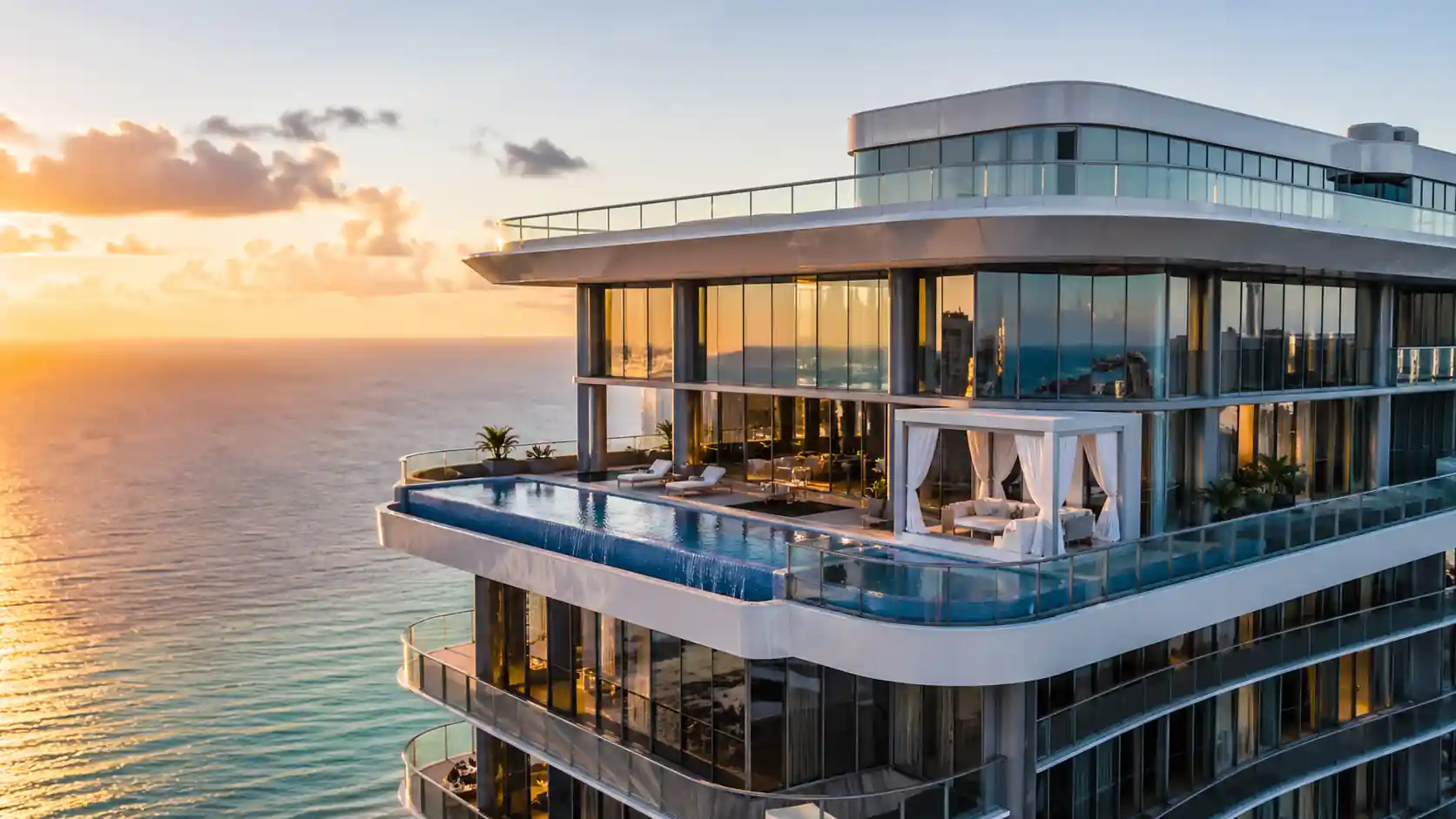
Selling a home in Miami in 2026 typically takes 53 days for single-family homes, 71 days for condos, and 88 days for luxury. Total seller costs run 8–9.5% of sale price including commission post the August 2024 NAR settlement. Foreign sellers face FIRPTA withholding of 15% (10% for $300K–$1M when buyer occupies as primary residence; 0% below $300K).
Median Miami-Dade single-family price
~$680K
May 2026
Typical days on market
53–88
Single-family to luxury
Total seller closing costs
8–9.5%
Including commission
Foreign buyer share
21%
Florida vs. all U.S.
In Miami, the difference between a home that sells in 60 days at the right number and one that sits for nine months and trades for less is rarely the property itself — it is the strategy. Pricing, presentation, exposure, and negotiation each carry weight, and a misstep on any one of them costs real money. The market in 2026 is more balanced than it was at the 2021–2023 peak, and buyers are scrutinizing condition, condo financials, insurance, and pricing logic more aggressively than they have in years.
This guide walks through the four jobs every Miami seller has: positioning the property, presenting it, marketing it, and closing it. The same playbook scales from a $500,000 Brickell condo to a $15,000,000 waterfront estate, with adjustments at each tier. Wherever you sit on that spectrum, the goal is the same — sell well, on your timeline, without leaving money on the table.
POSITIONING
SECTION 1
Price It Right the First Time
In a stable Miami market, the first 21 days on the MLS set the trajectory of the entire listing. A home that lands at the wrong number — even by 5% — accumulates showings without offers, then sits, then loses negotiating leverage as days on market climb. By day 60, you are typically negotiating from a weaker position than you would have been on day 1, often selling for less than a properly priced listing would have commanded out of the gate.
A comparative market analysis from a working agent — built on actual closed comps and adjusted for condition, finishes, view permanence, line and floor, and HOA financial health — is the only reliable input. Public estimates from Zillow and Redfin are useful sanity checks but consistently miss the building-specific and unit-specific factors that move Miami prices materially. The county tax-roll value reflects the political compromise of Save Our Homes caps, not the market. Treat both as background — with one exception. The gap between market value and your assessed value is your accumulated Save Our Homes benefit, and if your next home is also a Florida homestead, that benefit moves with you.
Strategic pricing sits just below buyer search brackets. A home priced at $1,995,000 surfaces in every search filtered to "under $2M" — and most buyers searching at $2.1M will see it too. A home priced at $2,025,000 disappears from the first group entirely. The same logic applies at $5M, $7.5M, and $10M brackets at the higher tiers.
For luxury and ultra-luxury, the picture changes. Days on market for properties above $3M ran 88 days in 2025 — meaningfully slower than 2024 — and pre-launch market testing through your agent's HNW network and co-broke relationships often outperforms pure on-market exposure.
SECTION 2
When to Hit the Market
Miami's seasonality is real, though less pronounced than markets further north. The strongest buyer pool window runs January through April: snowbirds shopping during their Florida months, international buyers traveling for the season, and end-of-fiscal-year capital deploying. A secondary window opens May through early summer, often with less competing inventory, which can favor a well-priced listing. August and September are the slowest months — vacation and hurricane season — and inventory listed in this window typically takes longer to attract attention.
Macro factors layer on top of seasonality. Interest rates affect the financed-buyer pool size, which matters more in the under-$2M segment than in luxury, where 47% of international buyers and a comparable share of domestic luxury buyers transact in cash. When rates move down even 50 basis points, financed buyer activity in Miami picks up within weeks.
Personal factors usually outweigh both. A relocation, a job start date, a life event, or capital gains planning sets a sell-by date that overrides market timing. Waiting for the "perfect" market often costs more than transacting now into the market that exists. The honest analysis is: what is my realistic price in the next 90 days, and what is the cost of waiting six months? For most sellers, that math favors moving when the decision is made, not when the market is theoretically ideal.
SECTION 3
Pre-Listing Inspections — When They Pay Off
For most resale homes in Miami, a pre-listing inspection is one of the highest-leverage moves a seller can make. The minimum set worth running: a general home inspection, a roof inspection by a licensed roofer, a wind mitigation report, and — for any home over 25 years old — a four-point inspection covering roof, HVAC, plumbing, and electrical. For condos in buildings approaching or past 30 years, add the building's most recent milestone inspection and Structural Integrity Reserve Study (SIRS) report to your disclosure package.
The case is straightforward. Buyers in Miami in 2026 are scrutinizing inspection findings more aggressively than at any point in the last decade. A surprise finding during the buyer's contingency window almost always costs the seller more than a fix done in advance — partly because the seller is now negotiating under time pressure, partly because the buyer's agent is incentivized to extract concessions exceeding the actual repair cost.
Issues worth fixing pre-listing: anything affecting insurability (roof age over 15 years, water intrusion, electrical panels under recall), anything visible during a showing (stucco cracks, water stains, dated GFCI outlets), and any deferred maintenance that would read as deferred to a buyer's inspector. Issues worth disclosing rather than fixing: aging-but-functional HVAC, cosmetic foundation hairlines, anything where the buyer might want their own choice of finish. Your agent helps you draw that line based on price tier and target buyer profile.
The disclosure duty is not optional. Under Johnson v. Davis, the 1985 Florida Supreme Court decision, you must disclose what you know that materially affects value and is not readily observable to a buyer. An as-is contract does not erase that duty. Statute layers specific written disclosures on top: flood (Florida Statute 689.302), radon (Florida Statute 404.056), and the property tax summary (Florida Statute 689.261). Federal law adds lead-based paint on most housing built before 1978.
Two more items belong in the pre-listing set. Run a municipal open-permit search before the buyer's team does: open or expired permits surface in title and lien work and stall closings, so resolve them before you list. And pull your CLUE report — the property's claims history, and the one document only you can order. The buyer's insurer will see it. See it first.
PRESENTATION
SECTION 4
Stage to Sell, Not to Live
Staging is not interior decoration. The job is to help a buyer mentally move in within the first ten seconds — which means the home reads as light, spacious, and aspirational without reading as anyone else's life. Light staging — vignettes, fresh linens, plants, art rotations, accent furniture — runs $2,000–$8,000 for a typical Miami home. Full furniture rental for a vacant or owner-occupied-but-dated property runs $8,000–$25,000+ depending on size and tier, and on luxury listings the argument for it is shorter time on market and a stronger final number — a judgment made property by property, not a return anyone can promise.
De-personalize without sterilizing. Family photos come down. Religious symbols come down. Personal collections come down. What stays: clean surfaces, intentional lighting, evidence of the lifestyle the home enables. Florida-specific moves matter: open every blind to maximize natural light (the single most-cited amenity in Miami listings), stage the lanai or pool deck as a living space, set the dining table for an outdoor dinner if the property has an indoor-outdoor flow.
Small fixes move the needle disproportionately. Fresh neutral paint on tired walls. New cabinet hardware. Modern bathroom faucets. Pressure wash the driveway, walks, and pool deck. Trim landscape and refresh mulch. Clean pool tile. None of these are large investments, and none get full reimbursement at closing — but their absence is what buyers remember when they leave a showing without making an offer.
SECTION 5
Photography, Video, and the Online First Impression
More than 90% of Miami buyers see the property online before they ever step inside, and the first six photos that surface in MLS thumbnails effectively decide whether a buyer schedules the showing. On a $1M+ listing, cheap photography is not a saving — it is a 1-3% reduction in your final sale price.
The baseline package for any Miami listing $750K and above: a professional photographer ($500–$2,500 depending on shoot length and tier), wide-angle interior coverage, exterior shots at the right time of day for the property's orientation, and a photo order that opens with the strongest single image rather than the front facade. Twilight photography ($500–$1,500 add-on) is worth it for any property with a pool, water view, or lit landscaping. Drone photography is essential for waterfront, large lots, and any home where context (neighborhood, water proximity, building amenities) is part of the story.
Video is no longer optional above $1M. A full property reel ($2,000–$8,000) lets out-of-market buyers — especially international — make a real decision before a flight. Vertical-format edits for Instagram and TikTok put the same footage in front of buyers who are scrolling rather than searching. A virtual tour or 3D walkthrough is now expected; its absence reads as a discount signal. For luxury listings $3M+, a custom property website with the full media package, neighborhood story, and floor plans converts serious buyers and impresses the agents who bring them.
SECTION 6
Repairs That Move the Needle (and Ones That Don't)
Not every repair earns its dollar back at closing. The Miami market — especially in 2026, with buyers focused on insurance, condo financials, and condition — rewards specific moves and ignores others.
High-ROI fixes: fresh neutral paint inside and on the front door; replace dated lighting and bathroom fixtures; modernize cabinet hardware; pressure-wash everything outdoor; refresh landscape mulch; clean pool tile and surface; repair screens; replace any obviously failed weather sealing. Each of these is sub-$2,000 work that meaningfully changes the buyer's first impression.
Medium-ROI fixes: roof replacement on a 20+ year roof if you intend to compete with comparable updated listings; HVAC replacement on systems over 12 years (insurance and inspection both flag these); window screen and seal replacement; minor stucco crack repair on highly-visible elevations. These are larger investments and return roughly dollar-for-dollar in price, but they remove objections that would otherwise cost more in negotiation.
Low-ROI fixes: full kitchen or bathroom renovation immediately before listing; expensive built-ins; pool resurfacing on a pool that just needs cleaning; anything taste-specific (bold paint, custom tile, dated luxury finishes). These rarely return their cost. Better to credit the buyer at closing and let them choose.
On the roof specifically: Florida law bars an insurer from refusing a policy on roof age alone when an authorized inspector certifies the roof has five or more years of useful life left, so on an older roof that inspection report is what keeps your buyer out of a Citizens policy. If you cannot replace, price the property to reflect the cost the buyer will absorb.
MARKETING & SHOWINGS
SECTION 7
Build the Exposure Plan
MLS is the floor, not the plan. A Miami listing that runs only on MLS-and-syndication and waits for the phone to ring is leaving exposure — and money — on the table. The full plan layers four channels.
First: MLS plus the major syndication portals (Zillow, Realtor.com, Redfin, Trulia) with optimized photo order, accurate amenity tagging, and a polished property description. Second: paid digital distribution on Meta and Google, run under their housing-ad rules — housing campaigns sit in a restricted category where audience targeting by age, gender, ZIP code or detailed interests is not available, so reach comes from search intent and broad placement rather than audience selection. Third: the agent's network — broker-only preview, direct outreach to agents with active matched buyers, pre-launch coming-soon for relationship buyers. Fourth: luxury-specific portals for $3M+ — Robb Report, Mansion Global, JamesEdition, and increasingly LuxuryEstate and Properstar for international reach.
For any listing $1M and above, a custom property website is a meaningful tool: a single URL with the full media package, floor plans, neighborhood story, and a contact CTA. It positions the listing at its price tier, captures direct inquiries (bypassing portal lead routing), and provides a clean shareable asset for agent-to-agent and seller-driven outreach.
The exposure plan should be written down before launch and reviewed at day 14 and day 30. If specific channels are underperforming, reallocate budget. If feedback patterns suggest the listing is being seen but not converting, the issue is rarely exposure — it is price, presentation, or both.
SECTION 8
Reach the International Buyer Pool
Florida captures 21% of all U.S. foreign-buyer activity and has held the top spot for 15 consecutive years. Miami sits at the center of that activity. Nearly half of international buyers in Florida pay all cash, which translates into faster closings, fewer financing contingencies, and a different competitive dynamic than the financed-buyer market.
Reaching this audience requires the listing to be discoverable and convertible in multiple languages. The agent's language capability matters here — this listing represents you in {languages}, which opens conversation channels that English-only marketing cannot. Listing copy translated for major international portals (JamesEdition, LuxuryEstate, Properstar) extends reach. WhatsApp, Telegram, and WeChat are the working communication channels for international buyer conversations — email response times and time-zone handling differentiate professional listings from amateur ones.
Logistics for international showings: virtual walkthroughs scheduled in the buyer's time zone, documents provided in advance of an in-person trip so the property is one of three or four candidates the buyer evaluates during a 48-hour visit, and clear FIRPTA and SB 264 expectations communicated upfront so neither side wastes time. International buyers typically arrive ready to transact if the marketing has done its job; the failure mode is a listing that looked great online and produced a wasted trip.
SECTION 9
Showings, Feedback, and the Two-Week Rule
Showing logistics in Miami have become more sophisticated in the last few years. ShowingTime is the standard scheduling layer for most listings; on luxury and ultra-luxury, agent-accompanied showings are the norm and lockbox access is reserved for trusted agent relationships. A clear showing window with reasonable notice maximizes traffic without disrupting the seller's life.
Every showing requires the home to be ready: lights on in every room, blinds open for natural light, pleasant ambient temperature (this is Miami — guests notice immediately if the AC is set high), no pets visible, fresh flowers or a subtle scent, music low and ambient. Pets and personal items reduce the buyer's mental engagement with the property. The discipline of showing readiness every day is exhausting, but it is the seller's primary contribution during the listing window.
The two-week rule: by day 14 of the listing, you should have a clear feedback pattern. If you have multiple showings and no offers, the issue is typically price or condition; if you have low showing volume, the issue is exposure or pricing brackets. Either way, an honest sit-down with your agent at the two-week mark — what is feedback telling us, what is the comparable listing pool doing, what would a 2-3% price refinement do — protects the listing from drifting into stale-listing territory. Repeat that review at day 30, day 45, and day 60 if needed.
OFFERS, NEGOTIATION & CLOSING
SECTION 10
Read Offers Like a Pro
Price is the headline of any offer, but the headline is one of seven variables that determine whether the offer is actually the best one in front of you.
The seven: (1) price; (2) earnest money deposit (5–10% is standard in Miami; higher signals stronger commitment); (3) financing — cash vs. conventional vs. foreign-national, and the lender's reputation if financed; (4) contingencies — inspection, financing, appraisal, and how each is structured; (5) closing timeline (does the buyer match your need to move quickly or stay longer?); (6) post-occupancy needs (rent-back, leave-behind personal property, included furnishings); (7) buyer seriousness signals (proof of funds quality, lender pre-approval depth, contingency periods kept tight, communication tone).
A cash offer at $1,950,000 with a 14-day inspection contingency and a 21-day close is often a stronger position than a financed offer at $2,000,000 with a 30-day financing contingency, an appraisal contingency, and a 45-day close. The certainty premium is real, especially in a market where buyer financing can fall apart between contract and closing. Run the math on net proceeds, time exposure, and execution risk on every offer.
Backup offers protect leverage. If your accepted offer falters, a recorded backup keeps the listing from a fresh marketing cycle. Multiple-offer scenarios should be handled with discipline and disclosure to all parties — you want competitive tension, not alienated buyers walking away.
SECTION 11
Negotiation, Counters, and Inspection Hurdles
A competent counter-offer is a tool, not a war. The goal is to land at terms both parties accept while protecting your floor on price and your timeline. In Florida, all negotiation should route through your agent — direct seller-buyer text threads almost always create problems and rarely solve them.
Inspection is where most Miami transactions are renegotiated. The buyer's inspector will produce findings; the buyer's agent will frame the findings as a request for repair, credit, or price reduction. Your honest options are: fix the items, credit the buyer at closing for the items, refuse and let the contingency play out, or split the difference. The right answer depends on the size of the ask versus your alternative buyer pool. A $5,000 credit on a $700,000 sale to keep the contract alive is almost always smarter than restarting marketing. A $50,000 credit on the same sale needs honest analysis.
Appraisal can derail financed transactions. If the appraisal comes in below contract price, the buyer can walk under the appraisal contingency, you can reduce the price, the buyer can bring more cash, or you can split the gap. Pre-listing appraisals are not standard practice but can be useful in soft submarkets to anchor pricing.
For foreign sellers: FIRPTA holdback (15% of gross sale price, with reductions when the buyer occupies as a primary residence) is built into the closing wire mechanics. Plan for it from day one with your CPA — funds held by the IRS pending return processing can take months to recover.
SECTION 12
Closing in Florida — What Sellers Actually Pay
Florida seller closing costs run 8–9.5% of the sale price all-in once commissions are included. The breakdown for a typical $1M Miami sale: real estate commission of approximately 5.5% (~2.7% to the listing side, ~2.8% to the buyer side, both negotiable since the August 2024 NAR settlement); documentary stamps on the deed, which in Miami-Dade run $0.60 per $100 plus a $0.45 per $100 county surtax on anything other than a single-family dwelling (0.6% of sale price on a house, 1.05% on a condo); and settlement and closing fees, recording, HOA estoppel, prorated taxes, and miscellaneous (~0.5–1%). Title insurance runs about 0.5% of the price, but by local custom the buyer pays it in Miami-Dade and Broward and the seller pays it in Palm Beach.
The NAR settlement changed how buyer-side commission is presented and negotiated, but the practical reality in 2026 is that most Miami sellers still offer buyer-side compensation as a marketing decision — listings that don't tend to attract fewer showings and slower contracts. The change for sellers is that the offer is now explicit, negotiable, and disclosed, rather than embedded by default.
For foreign sellers, FIRPTA withholding is 15% of the gross sale price, reduced to 10% for sales between $300K and $1M when the buyer signs a primary-residence affidavit, and waived under $300K under the same condition. The withheld amount is a deposit toward your eventual U.S. tax liability — recoverable via a U.S. tax return — not an additional tax. Plan with a CPA who handles foreign-seller files.
Wire fraud is the single biggest closing-day risk. Verify wire instructions for the proceeds wire by phone, on a number you confirmed independently. Every time. The Home Sale Proceeds Calculator and FL Seller Closing Cost Calculator on this site let you model your net before you list.
Mistakes That Cost Sellers Real Money in Miami
Over-pricing into the void
The most common and most expensive mistake. Listing 8% above the market clears no offers in the first 21 days, then sits, then takes 3-5% reductions over the next 60 days, and finally trades for 4-7% below where a properly priced listing would have closed. The ego cost of pricing right is small. The financial cost of pricing wrong is large.
Cheap photography on a luxury listing
On a $2M+ property, the difference between professional photography and iPhone photography is routinely 1-3% of final sale price. That is $20K-$60K of difference for a $1,500-$3,000 photographer fee.
Skipping pre-listing repairs that wreck the inspection
Credits given under buyer time pressure are always larger than the same fix done before listing. A $4,000 roof flashing repair becomes a $12,000 credit when the buyer's inspector flags it during a 14-day contingency window.
Underestimating FIRPTA timing
Foreign sellers who do not pre-plan with a CPA can have closing wire proceeds tied up for months. This is preventable with the right paperwork started 60-90 days before closing.
Ignoring the SIRS reserve study and milestone inspection on older condos
Buyers in 2026 are reading these documents carefully. Special assessments in progress, deferred reserves, or a building three months from a milestone deadline will lose buyers in due diligence. Disclose proactively, price honestly, and the right buyer transacts.
Selling "as-is" and assuming that ends your disclosure duty
It does not. An as-is clause limits what you must repair, not what you must reveal. Concealing a known defect turns a closed sale into a post-closing lawsuit.
Leaving your Save Our Homes savings on the table
If your next home is a Florida homestead, the assessment differential you accumulated on this one is portable — but only if you claim it, on Form DR-501T, with the new homestead application. The window is short: currently three tax years from the year you leave the old homestead. On a home held for a decade or more the differential can be large — your county property appraiser's site shows yours.
DIY wire instructions
Wire fraud is the single most common closing-day disaster. A spoofed email from "the title company" with new wire instructions has emptied seller accounts. Verify by phone, on a confirmed number, every time.
Over-pricing into the void
The most common and most expensive mistake. Listing 8% above the market clears no offers in the first 21 days, then sits, then takes 3-5% reductions over the next 60 days, and finally trades for 4-7% below where a properly priced listing would have closed. The ego cost of pricing right is small. The financial cost of pricing wrong is large.
Cheap photography on a luxury listing
On a $2M+ property, the difference between professional photography and iPhone photography is routinely 1-3% of final sale price. That is $20K-$60K of difference for a $1,500-$3,000 photographer fee.
Skipping pre-listing repairs that wreck the inspection
Credits given under buyer time pressure are always larger than the same fix done before listing. A $4,000 roof flashing repair becomes a $12,000 credit when the buyer's inspector flags it during a 14-day contingency window.
Underestimating FIRPTA timing
Foreign sellers who do not pre-plan with a CPA can have closing wire proceeds tied up for months. This is preventable with the right paperwork started 60-90 days before closing.
Ignoring the SIRS reserve study and milestone inspection on older condos
Buyers in 2026 are reading these documents carefully. Special assessments in progress, deferred reserves, or a building three months from a milestone deadline will lose buyers in due diligence. Disclose proactively, price honestly, and the right buyer transacts.
Selling "as-is" and assuming that ends your disclosure duty
It does not. An as-is clause limits what you must repair, not what you must reveal. Concealing a known defect turns a closed sale into a post-closing lawsuit.
Leaving your Save Our Homes savings on the table
If your next home is a Florida homestead, the assessment differential you accumulated on this one is portable — but only if you claim it, on Form DR-501T, with the new homestead application. The window is short: currently three tax years from the year you leave the old homestead. On a home held for a decade or more the differential can be large — your county property appraiser's site shows yours.
DIY wire instructions
Wire fraud is the single most common closing-day disaster. A spoofed email from "the title company" with new wire instructions has emptied seller accounts. Verify by phone, on a confirmed number, every time.
Over-pricing into the void
The most common and most expensive mistake. Listing 8% above the market clears no offers in the first 21 days, then sits, then takes 3-5% reductions over the next 60 days, and finally trades for 4-7% below where a properly priced listing would have closed. The ego cost of pricing right is small. The financial cost of pricing wrong is large.
Cheap photography on a luxury listing
On a $2M+ property, the difference between professional photography and iPhone photography is routinely 1-3% of final sale price. That is $20K-$60K of difference for a $1,500-$3,000 photographer fee.
Skipping pre-listing repairs that wreck the inspection
Credits given under buyer time pressure are always larger than the same fix done before listing. A $4,000 roof flashing repair becomes a $12,000 credit when the buyer's inspector flags it during a 14-day contingency window.
Underestimating FIRPTA timing
Foreign sellers who do not pre-plan with a CPA can have closing wire proceeds tied up for months. This is preventable with the right paperwork started 60-90 days before closing.
Ignoring the SIRS reserve study and milestone inspection on older condos
Buyers in 2026 are reading these documents carefully. Special assessments in progress, deferred reserves, or a building three months from a milestone deadline will lose buyers in due diligence. Disclose proactively, price honestly, and the right buyer transacts.
Selling "as-is" and assuming that ends your disclosure duty
It does not. An as-is clause limits what you must repair, not what you must reveal. Concealing a known defect turns a closed sale into a post-closing lawsuit.
Leaving your Save Our Homes savings on the table
If your next home is a Florida homestead, the assessment differential you accumulated on this one is portable — but only if you claim it, on Form DR-501T, with the new homestead application. The window is short: currently three tax years from the year you leave the old homestead. On a home held for a decade or more the differential can be large — your county property appraiser's site shows yours.
DIY wire instructions
Wire fraud is the single most common closing-day disaster. A spoofed email from "the title company" with new wire instructions has emptied seller accounts. Verify by phone, on a confirmed number, every time.
The Seller's Checklist
Before listing
Pull comps and review CMA with your agent
Decide pricing strategy and strategic price point
Schedule pre-listing inspections (general, roof, four-point + wind mitigation if 25+ year home)
Book staging consultation; complete light staging or full furniture rental
Complete high-ROI repairs (paint, hardware, pressure wash, landscape, pool tile)
Schedule professional photography, twilight, drone, video reel as appropriate to tier
Complete written disclosures: known material defects, flood history (Florida Statute 689.302), radon, lead paint if pre-1978
Order a municipal open-permit search; close or resolve open permits before listing
Pull your CLUE claims-history report and review it before buyers' insurers do
Prepare HOA documents, milestone inspection summary and SIRS report (condos)
If foreign seller: engage CPA on FIRPTA planning 60-90 days before listing
During the listing window
Maintain showing-readiness every day (lights, blinds, scent, AC, no pets visible)
Confirm every showing through ShowingTime; respond to feedback within 24 hours
Review feedback patterns weekly with your agent
Hold a price/strategy review at day 14, day 30, day 45 — refine if data warrants
Respond to offers within 24-48 hours
Evaluate every offer on all seven variables, not just price
From contract to closing
Lock contract; deposit earnest money to escrow
Manage inspection response thoughtfully (fix, credit, refuse, or split)
Monitor financing milestones if buyer is financed
Schedule moving plan and utilities transfer
Prepare HOA estoppel and final HOA dues calculation
Verify proceeds wire instructions by phone on a confirmed number
Attend closing or pre-sign with title company
Hand over keys, fobs, garage remotes, alarm codes, pool/spa manuals, and HOA documents
File final tax documents and FIRPTA paperwork (foreign sellers) with your CPA
If your next home is also a Florida homestead: file for portability (Form DR-501T) with the new homestead application
Frequently Asked Questions
Common questions about selling property in Miami
How long does it actually take to sell a home in Miami in 2026?
+
Single-family homes in Miami-Dade are averaging about 41 days to contract, condos around 64 days, and luxury properties above $3M roughly 88 days. Total time from listing to closing usually adds another 30-45 days for financed buyers and 15-30 days for cash. The market is more balanced than the 2021-2023 peak, so realistic expectations on day-on-market matter.
What does it really cost me at closing as the seller?
+
Plan for 8-9.5% of the sale price all-in once commissions are included. The breakdown: ~5.5% commission (typically split between listing and buyer side, both negotiable post the August 2024 NAR settlement), 0.6% in deed documentary stamps on a single-family home in Miami-Dade (1.05% on a condo, where the county surtax applies), and ~0.5-1% in settlement, recording, and HOA estoppel fees. Title insurance, about 0.5%, is customarily the buyer's cost in Miami-Dade and Broward, so it does not sit on your side of a Miami sale. On a $1M sale, expect $80,000-$95,000 in seller-side closing costs.
Should I sell first or buy first?
+
It depends on your liquidity and risk tolerance. Selling first locks in your equity but creates a temporary housing problem. Buying first eliminates that problem but exposes you to carrying two mortgages and forces a sale on the buyer's clock. The middle path — sale contingent on suitable replacement, or a bridge loan — works for many. Talk through the trade-offs before committing to a timeline.
I'm a foreign owner — what do I do about FIRPTA?
+
FIRPTA withholds 15% of the gross sale price (reduced to 10% for sales $300K-$1M sold to a buyer using as primary residence; waived under $300K with the same condition). Withholding is recoverable via a U.S. tax return — it's a deposit, not an additional tax. Engage a CPA who handles foreign-seller files at least 60-90 days before closing to file a withholding certificate where applicable and avoid funds being tied up unnecessarily.
How does the August 2024 NAR commission settlement affect me?
+
Three changes matter for sellers in 2026. First, buyer-side compensation can no longer be offered through the MLS — it must be offered directly, in a written buyer-broker agreement or as a separate concession. Second, buyers are now required to sign a compensation agreement with their agent before touring, which means every serious buyer already has a documented expectation. Third, the practical effect on most Miami listings is that sellers still offer buyer-side compensation as a marketing tool — it is now explicit and negotiable rather than automatic. The amount, typically 2.5-3%, is now a conversation rather than an assumption.
My property has been sitting — what do I do?
+
The answer depends on feedback. If you have high showing volume but no offers, the issue is almost always price or presentation — address one or both. If you have low showing volume, the issue is exposure or pricing-bracket placement. In either case, a candid agent review at day 30 is the right move. A price refinement of 2-3% at day 21-30 often resets momentum; a price reduction of 5%+ at day 60+ is less effective but sometimes necessary. Pulling the listing and relaunching 30-60 days later can help if you make meaningful changes — price, condition, or photography — before relaunching.
How do I handle an offer from an international buyer?
+
The mechanics are similar to a domestic transaction with three additions: confirm proof of funds carefully (wire confirmations from foreign banks require extra verification time); clarify SB 264 eligibility if the buyer holds a passport from a listed country; and build FIRPTA expectations into your closing timeline if applicable to your own situation as the seller. International cash buyers often move decisively once they have committed — the pace can be faster than a financed domestic transaction once both sides are aligned.
I'm selling as-is — do I still have to disclose problems?
+
Yes. Under Johnson v. Davis, the 1985 Florida Supreme Court decision, a seller who knows of facts materially affecting the property's value that are not readily observable to the buyer must disclose them — an as-is contract limits what you must repair, not what you must reveal. Material means it would move what a reasonable buyer pays: active leaks, structural movement, repeated flooding, unpermitted work. Disclosing in writing protects you too — it turns a later argument about what you knew into a document.
Can I take my Save Our Homes savings to my next house?
+
Yes, if the next house is also a Florida homestead. Portability lets you carry the assessment difference built up on your current homestead to the new one, up to $500,000 of that difference under the current statute. It is not automatic — you file Form DR-501T with the homestead application on the new property. The new homestead must be established by January 1 of the third tax year after you abandon the old one. If you downsize, the benefit transfers proportionally rather than dollar for dollar.
The buyer's inspector found an open permit from years ago — what now?
+
Expect the closing to wait until you cure it. Open or expired permits surface in municipal permit and lien searches, in title work, and in the buyer's inspection. The cure is either closing out the original permit — the final inspection the prior contractor never called for — or applying for a retroactive permit and bringing the work to current code. Both take weeks. A known open permit that affects value also falls within the Johnson v. Davis disclosure duty — which is why that search belongs in your pre-listing set, not the buyer's.
Curious what your home is worth?
Schedule a complimentary valuation to see what your property would realistically sell for in the next 90 days, what it would cost you at closing, and what your net would look like. The conversation is free, works in English, Russian, and can happen by phone, video, or in person — at your convenience.
This guide covers the full selling process, but the rest of your toolkit is already built out on this site. The Home Sale Proceeds Calculator and the Florida Seller Closing Cost Calculator let you model your net before you ever list — adjust for sale price, commission structure, and property-specific costs to see real numbers in minutes. If you are a foreign seller weighing FIRPTA timing or a buyer planning a 1031 exchange, the Relocation Guide covers the international and cross-border layer in parallel depth.
When you are ready to evaluate the buyer-side dynamics in your submarket — what current inventory looks like, where your property sits relative to active listings, and what your eventual buyer pool is shopping — Map Search and Featured Properties give you a live view of South Florida. The Neighborhood Quiz is useful when you are selling in one neighborhood and considering the move to another. Every tool on this site does the same job: it puts a number where a guess would otherwise sit.
Disclaimer: This guide is provided for informational purposes only and does not constitute legal, tax, financial, or immigration advice. Market data reflects conditions in Miami-Dade as of May 2026 and changes continuously. Florida-specific FIRPTA obligations, SIRS reserve requirements, NAR settlement implications, and condo disclosure rules are complex and fact-specific — confirm all details with a licensed Florida real estate attorney and a qualified CPA before listing or accepting an offer.